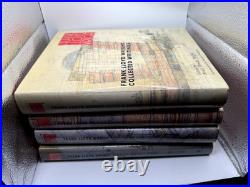
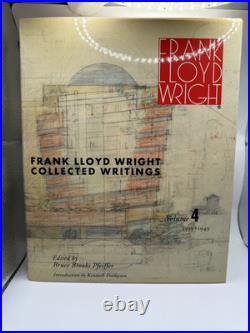
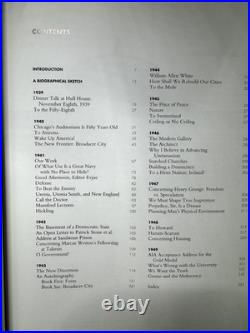
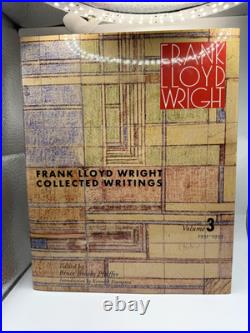
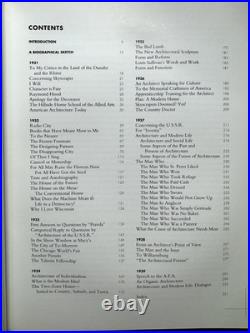
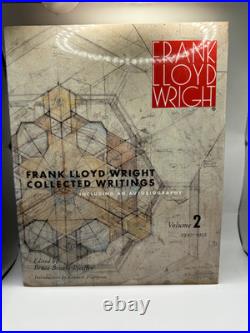
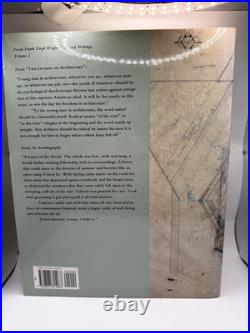
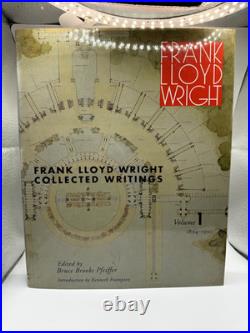
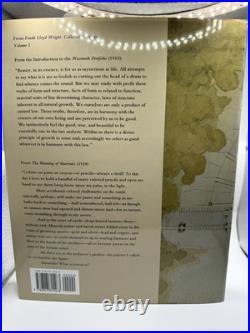
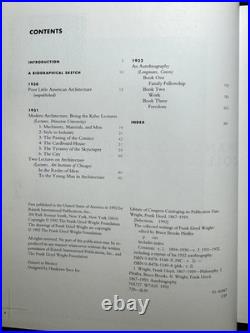
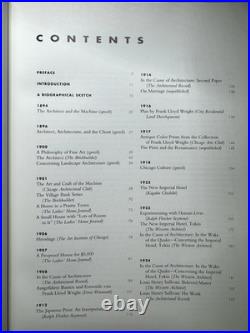
The Frank Lloyd Wright Collected Writings Volume 01-04 Set by Rizzoli is a comprehensive collection of the renowned architect’s works, exploring his thoughts on art, culture, and architecture. Published in 1992, these hardcover books delve into the insights and ideas of Frank Lloyd Wright, providing readers with a deeper understanding of his design philosophies and techniques. Written in English, this set offers a comprehensive look at the influential work of one of the most iconic architects of the 20th century. Wright, one of America’s premier architects, was also a prolific and imaginative writer, and this book, the first of a projected six-volume set, successfully reintroduces his literary works. The volume is comprised of published and unpublished essays, lectures, articles, and personal reminiscences written between 1894 and 1930. The scope of these writings is wide, their styles diverse. They range from the highly technical to the philosophical to the poetic, yet each essay contributes toward a fuller understanding of Wright’s beliefs about art and architecture. The essays are enhanced by well-written commentaries and extensive footnoting, and the book is well illustrated with both high-quality photographs and drawings. Essential for both lay readers and professionals interested in art, art history, and architecture; recommended for both public and academic libraries. See also Meryle Secrest’s Frank Lloyd Wright: A Biography, reviewed on p. Glenn Masuchika, Chaminade Univ. Frank Lloyd Wright: Collected Writings, Volume 2. From “Two Lectures on Architecture”: Young man in architecture, wherever you are, whatever your age, or whatever our job, we– the youth of America– should be the psychological shock-troops thrown into action against corruption of this supreme American ideal. It will be for youth, in this sense, to win the day for freedom in architecture. ” “To the young man in architecture, the word. Should be a beautiful word. Radical means “of the root” or “to the root”– begins at the beginning and the word stands up straight. Any architect should be radical by nature because it is not enough for him to begin where others have left off. A house of the North. The whole was low, wide and snug, a broad shelter seeking fellowship with its surroundings. A house that could open to the breezes of summer and become like an open camp if need be. With Spring came music on the roofs for there were few dead spaces overhead, and the broad eaves so sheltered the windows that they were safely left open to the sweeping, soft air of the rain. Taliesin was grateful for care. Took what grooming it got and repaid it all with interest. Taliesin’s order was such that when all was clean and in place its countenance beamed, wore a happy smile of well-being and welcome for all. It was intensely human, I believe. In any collected writings of an artist, one must include a very big “bad” with little goods. ” In this book, the second of a projected six-volume set (for a review of the first volume, see LJ 9/1/92), the big “bad is Wright’s autobiography, which takes up two-thirds of the book. First published in 1932, this rambling, poorly told, sometimes barely coherent life history has not improved with time. It is surprising that Wright, who wrote forcefully yet lyrically, would record his life in such a dull, self-indulgent manner. Yet this volume is redeemed by the little “goods”:the lectures Wright delivered in 1931 at Princeton University and the Art Institute of Chicago. These show Wright at his best, and they aptly summarize thoughts derived from three decades of conscious deliberations as an architectural philosopher and prophet. Recommended for architectural libraries. For more on Wright, see the review of Kathryn Smith’s FLW, p. His writings have become indispensable inclusions in architecture libraries and have influenced generations of architects, city planners, designers, environmentalists, and architectural enthusiasts in this country and throughout the world. This is the fourth volume in the highly acclaimed series of Wright’s written works, most of which are out of print and have never before been systematically compiled for publication. Arranged chronologically, Volume IV includes the years of world conflict and postwar recovery– a rich, prolific period during which Wright created designs for some of his best-known buildings. The predominant themes of these writings are his outspoken antiwar stance, his political isolationism, and his magnificent plan for living in the late twentieth century– Broadacre City– which he offers as a challenge to materialism and as a means of rehumanizing the nation and its citizens through decentralization. The essays here consist of published and unpublished manuscripts, as well as the Taliesin Square-Papers, which Wright privately published in the early 1940s as a non-political voice from our democratic minority. The writings not only look forward to new solutions but also reflect poetically on his life’s work and the sources of his inspirations. Included here are the final book of his autobiography, composed primarily of personal reminiscences, as well as a discussion of life with the members of the Taliesin Fellowship, his school and apprenticeship system, and his lasting tribute to his great teacher, Louis Sullivan, in Genius and the Mobocracy. His architectural message is consistent with his previous writings: the United States needs an architecture that will reflect the democratic values of the nation and encourage the creative life of the individual. Wright also continues his attack on the International Style, decrying its lack of cultural character and soulless universality. Wright created more than 200 designs during this period– highlighted by the Solomon R. Guggenheim Museum, the S. Johnson and Company Research Tower, and the Florida Southern College campus, as well as factories, theaters, civic centers, and more than 100 residential designs, many of which are illustrated here with previously unpublished drawings.